
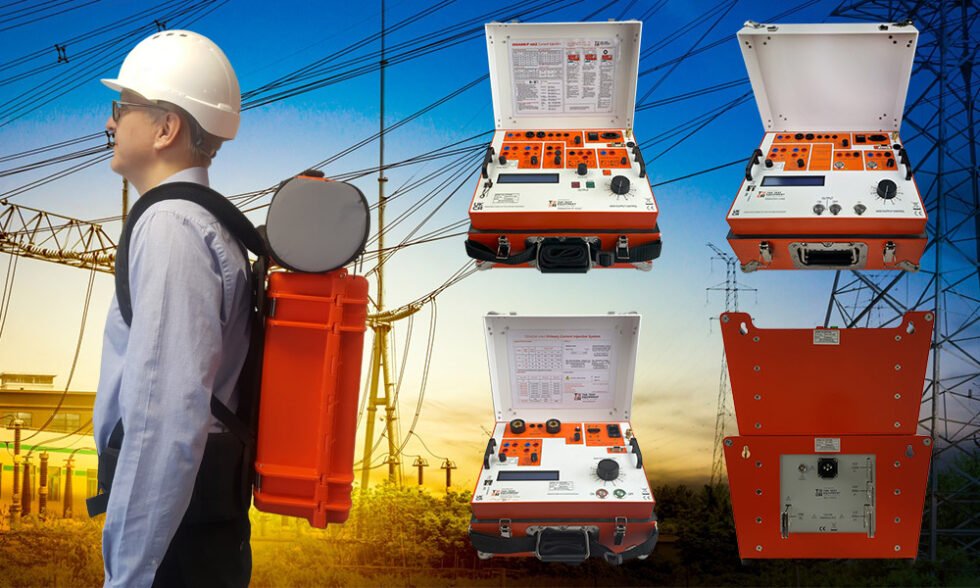
T&R Test Equipment Ltd. recently held the second session of its High Voltage Testing Workshop…
Why Substation Commissioning Matters
Substation commissioning is the final, critical process of verifying that electrical equipment, such as transformers, circuit breakers, and protection relays, is installed correctly, functions according to design, and is safe to operate before being energized.
At the heart of this process lies primary and secondary current injection testing — essential methods used to validate protection schemes, verify system integrity, and ensure every component performs as intended under real conditions.
The Role of Commissioning in Power Systems
Substations are complex environments where multiple systems must work together seamlessly. Protection relays, current transformers (CTs), circuit breakers, and control wiring all form part of a coordinated protection scheme.
Commissioning ensures that:
- Protection systems operate correctly under fault conditions
- CT ratios and polarity are verified
- Trip circuits function as expected
- Timing characteristics meet design requirements
- Wiring and configuration errors are identified before energisation
Without thorough testing, even minor issues can lead to nuisance tripping, equipment damage, or failure to operate during faults.
Secondary Injection Testing: Precision at Relay Level
Secondary injection testing focuses on the relay and control circuit. By injecting low-level currents and voltages directly into the relay, engineers can verify its functionality without involving the primary system.
This approach is ideal for:
- Relay calibration and settings verification
- Functional testing of protection schemes
- Timing analysis (trip, reset, reclose)
- Fault simulation under controlled conditions
Instruments such as the 50ADM-P and 200ADM-P are particularly well suited for this stage. With features like true RMS metering, single-cycle capture, and advanced timing systems, they allow engineers to carry out accurate, repeatable tests with confidence.
Their ability to store results, waveforms, and harmonic data also supports detailed analysis and reporting — an increasingly important requirement in modern commissioning practices.
Primary Injection Testing: End-to-End System Validation
While secondary injection verifies the relay, primary injection testing validates the entire protection chain.
By injecting high current into the primary circuit, engineers can test:
- Current transformers under real load conditions
- Complete protection paths from CT to relay to breaker
- Circuit breaker operation and trip performance
- Overall system response to fault scenarios
This method is essential for identifying issues that secondary testing alone cannot detect — such as wiring errors, incorrect CT connections, or mechanical problems within breakers.
High-current systems like the 750ADM Mk4 are designed for this purpose, delivering the power and control needed to simulate real operating conditions. With fast data capture, flexible timing systems, and multiple output ranges, they enable accurate and efficient end-to-end verification.
Preventing Failures Before They Happen
The importance of injection testing becomes clear when considering what is at stake.
Without proper commissioning:
- A relay may fail to trip during a fault
- A circuit breaker may operate too slowly — or not at all
- Incorrect CT connections may lead to false readings
- Protection schemes may not coordinate correctly
Each of these scenarios can result in equipment damage, extended outages, or safety risks for personnel.
By contrast, thorough testing with the right equipment ensures that faults are identified and resolved before the system is energised.
Choosing the Right Tools for the Job
Effective commissioning depends not only on methodology, but also on the quality and capability of the test equipment used.
Instruments such as the 50ADM-P, 200ADM-P, and 750ADM Mk4 provide a practical balance of:
- Accuracy and repeatability
- Flexible output ranges for different applications
- Advanced timing and measurement capabilities
- Data storage and reporting functionality
- Robust design for field use
These features make them well suited to the demands of modern substations, where testing requirements are becoming more complex and documentation more critical.
Supporting Safe and Reliable Networks
Substation commissioning is not just a procedural step — it is a safeguard for the entire power system.
Primary and secondary injection testing ensure that protection schemes operate correctly, systems remain stable under fault conditions, and infrastructure can be energised with confidence.
With the right approach and the right tools, engineers can move from uncertainty to certainty — ensuring that when a fault occurs, the system responds exactly as designed.
Looking to strengthen your commissioning process?
Explore how advanced injection testing solutions from T&R Test Equipment Ltd. can support accurate, efficient, and reliable substation testing.
Our entire product range is available through our partners in the United Kingdom, such as Acutest, Alpha Electronics, Cuthbertson Laird, Norwich Instrument Services, and PASS Ltd. Additionally, if you are located outside Great Britain, you can conveniently order our instruments through our worldwide distribution network.
Related Posts

T&R Test Equipment Ltd. will be exhibiting at Middle East Energy 2026, taking place from…
After a period of limited availability, the DMO200 Digital Micro-Ohmmeter from T&R Test Equipment Ltd…
Comments (0)